Showing posts with label Stoicism. Show all posts

Friday, 15 November 2024

Book Review: The Epictetus Club

Book Review: The Epictetus Club


Review By Casey Douglass


The Epictetus Club Cover


If you are interested in Stoic philosophy, and if you are anything like me, you might enjoy books or other media that give examples of said philosophy being applied by someone to improve their life. Jeff Traylor’s The Epictetus Club is one such book, and it tells of the ways in which a group of inmates at the Ohio Penitentiary attempt to live the philosophy of the Stoics.


Jeff’s introduction reveals that The Epictetus Club is very much inspired by real events, places and people, but that locations may have been changed and fictional composites used for some of the characters to help craft the story. Jeff explains that he taught a course about cognitive skills in a community-based correctional facility, and that he hoped that this book might provide a valuable aide memoire for the men he’d been teaching.


Jeff soon realised that the book could help other souls in various parts of the correctional system who might not have access to classes such as the one that he taught. He also points out that the book provides some ideas and a great analogy for people who aren’t currently living in the prison system, as the four walls of a prison align well with the mental walls that box in our thinking.


The main inmate character is Zeno, a lifer who happens to find a copy of Epictetus’s book The Enchiridion under the mattress in his new cell. This is a pleasing nod to the oft quoted origin of Stoicism, where Zeno of Citium is said to have suffered a shipwreck which sets him on the path to creating Stoicism. However, whereas the Zeno of the ancient world was a rich merchant, the Zeno of The Epictetus Club is a former professional boxer.


The Epictetus Club itself is run by Zeno under the supervision of a suitable staff advisor, which becomes Jeff once the previous advisor takes a new job elsewhere. The club meets once per week and allows inmates to learn about how their own thoughts trip them up in life. This is achieved with a number of boxing skill comparisons and much discussion about how to apply reason in situations from the inmates’ lives.


There is a lot to like about The Epictetus Club. I like the way that it distils some Stoic philosophical principles down to understandable conversations that aren’t complicated by obscure terms. There are also some exercises and approaches that don’t seem to be from Stoic philosophy too, but they do gel quite nicely with the more obvious Stoic ideas. The book touches on a decent amount of classical Stoic concepts, such as what is and isn’t in our control, living in accordance with universal and personal nature, playing your role in life, analysing your representations to see if they are true, and how our value judgments can cause us all sorts of problems.


There were a couple of things that I didn’t like quite so much, but they were more down to my own personal taste than anything. One is that, even though I appreciate the setting and how the inmates were being reached, the boxing metaphor doesn’t sit that well with me. Decades of struggling with OCD have shown me time and again that being adversarial with your thoughts isn’t the best approach to peace of mind. Then again, there are examples in the original Stoic texts that use training and sports as metaphors so it is actually quite fitting.


The other thing is that, even though it’s always nice to see examples of people adopting new ideas and using them to improve their lives, it can be a little deceptive how easily some people seem to take to these ideas. I guess what I mean to say is that there seems to be very little struggle with this for some of the characters in this book.


An example is when Jeff reads something from The Enchiridion when he was potentially at risk in a scary situation. It put his mind at ease and he felt much calmer, which is wonderful, but also seems a little too perfect. My own experience with Stoicism is that it takes much awareness and contemplation to adopt the concepts into your outlook on life, even if initially you intellectually accept and agree with them. Once strong emotions (or passions) arise in you in a situation, it’s amazing how quickly this new way of thinking can evaporate.


The Epictetus Club is a great accessible glimpse into how Stoic philosophy has been used to help inmates come out of prison in a better state than the one they were in when they entered. It introduces the reader to a number of Epictetus’ teachings, and weaves them into real-life problems and situations that, while likely different to what the reader is experiencing in some ways, will share some common elements that might just make a mental lightbulb flare in recognition. It may even kindle a desire to learn more about Stoic philosophy in the future.


Book Title: The Epictetus Club

Book Author: Jeff Traylor & Inmate Zeno

Publisher: Papillon Press. Reprinted by Drinian Press.

Published: August 2004

ISBN-13: ‎ 978-0941467094

Price: Currently between £10-£20 depending where you can find it

Friday, 23 June 2023

Stoicism: Stoa App Review

Stoicism: Stoa App Review


Review by Casey Douglass


Stoa App


The philosophy of Stoicism gained its name by being taught on the “painted porch”, or stoa, in ancient Greece. It was a philosophy very much of the people, and its street-side nature was as open a way as any for passers-by to have their interest piqued. Stoa is a smartphone app that aims to bring Stoicism to our modern “digital streets”, in the hope that many more people might experience the benefits of the mindful Stoic outlook on life.

I won’t go too in-depth about what Stoicism is, save to say that the Stoic philosophy is very different to being small “s” stoic. The first is aware of the role that our value judgements play in everyday life, those things that we label as good or bad, and the way that these judgements affect our emotions. A Stoic wants to develop their character and to live well in the world. The latter tries to hide all external expression of certain emotions, and more than likely tries to repress them so that they don’t even feel them. The first is wise. The latter is a breakdown (or a meltdown) waiting to happen.


Stoa App Courses
A brief look at some of the courses

Stoa gives the user access to a whole host of meditations and teachings from the ancient Stoics, and it does this by letting the user digest concepts in small, manageable routines. Each day, the main page of Stoa will present your current lesson, broken down into a number of sections: A quote, the theory behind it, a meditation practice incorporating this idea, an invitation to make a commitment to practise, and a chance to note if you followed through. I really appreciated this layout, as often, any internal resistance towards starting the daily lesson was soon banished by even just reading the quote, a micro-action that takes all of a few seconds.

When I first started to explore the Stoa app, I also happened to slip into a severe period of depression (unrelated to using the app). Even though I’ve read about, and attempted to practise, Stoic philosophy for a decent number of years now, I still found myself struggling to muster the motivation to even look inside the app. This is where each lesson being broken down into tiny steps really helped, as I just tried to read the quote each day. Some days, once I’d read the quote, I saw that the theory audio was so short (often only a few minutes) that I thought I’d listen to that too. After this, I was almost half way through the lesson, although I often stopped when I got to the meditation section, as at the time, I couldn’t cope with some of those.


Stoa App Main Page
The Stoa App main page

The meditations are really well done and helpfully give the listener some guidance with how to reflect on and digest the notions of the day. I did enjoy the more mindfulness-based ones but during my dip into depression, I found a good number of the meditations included elements that required me to think about a problem and to visualise it in a new way, such as how I’d most like to respond. This is valuable advice and direction but I just couldn’t do it while depressed; my mind couldn’t even grasp some of the concepts that I already knew at that point. I was just content to read my quote and listen to my lesson of the day.

When using Stoa, you aren’t restricted to the lesson of the day, there are all manner of other audio and written resources in the app. You can delve into various elements of Stoic theory, learn about the lives of the most well-known Stoics, such as Marcus Aurelius and Epictetus, and even listen to some brilliant conversations about Stoic topics, conducted between the Stoa team, or with other experts in the field. You can access some of these conversations at Stoa Conversations. I really valued listening to these conversations as they often branched out into other areas of life, such as creativity, how to deal with bullying, and with fake news. A good chunk of my “minutes” shown below came from listening to the podcasts.

Stoa App Streak
My best month regarding my "streak"

Stoa was created by Caleb Ontiveros and Michael Tremblay, two philosophy lovers who have come together to spread a little more Stoic wisdom in the world. While there are already some excellent books that break Stoic ideas down into day-sized chunks, Stoa really benefits from its digital form and the way that we nearly always have our smartphones close at hand. The mild gamification (streak counting) and the low-effort positive psychological principles in the app design (such as pressing a button to commit to your practice) all create a feeling of progressing, without hitting you over the head with too much. Stoicism is, after all, a life-long process, where repeated visits to a topic, with many periods of reflection, is usually needed to get said topic to travel from “head to heart” so to speak. From mere thought to knowing. Stoa makes this a pleasing, interesting experience and, even if I don’t keep those streaks going, I know it’s an app that I will return to again and again.

You can find out more information about Stoa on the website. Pricing details are below, and also links to the Apple and Google app stores. If you are interested in the app and genuinely can't afford it, you can also get in touch with Stoa who will give you a free account. You can find details about this on their website.


I was given free access to this app for review purposes


App Name: Stoa

Developer: Zeno Apps LLC

Platforms: Apple App Store & Google Play Store

Price: Free 7 day trial, then £8.99 / $9.99 per month or £46.99 / $69.99 per year.

Sunday, 11 June 2023

Dark Ambient: The First Year of Reality Scruncher

Dark Ambient: The First Year of Reality Scruncher


Reality Scruncher

Things often exist without a name, even if that label is created a little later. Before the notion of Reality Scruncher came along, I found myself attempting to create music similar to the artists that I most enjoy, trying to capture that glorious, awe inspiring quality that the dark ambient genre holds.

I enjoyed creating sinister drones. I enjoyed wandering the house with my Zoom H1 in hand, creating my own field recordings to toy with. I enjoyed how a track coalesced into something, that even with my own lack of music creation chops, nevertheless, sounded like what I was hoping for.

My initial tracks ended up on my Soundcloud page and as a handful of videos on my YouTube channel, but not for long. I don’t really rate Soundcloud as a platform, it mainly seemed like “bot-city” to me, and so I deleted my years old account. My YouTube offerings got culled when I left social media in the Summer of 2022, although I did ultimately return to YouTube as it’s the most convenient place to post videos, in my opinion anyway.

A few months later, I got the itch to attempt to merge some of my previously created tracks into an entire dark ambient album and put it up for free on Bandcamp. This turned out to be Deep Space Impingement, a rumbling, droning space-infused album in a minimalist horror style. This is also when I had to create my music project name, concocting Reality Scruncher as a reference to the other realities that I hoped to create and destroy with my music.

I gave out a lot of free Bandcamp codes for Deep Space Impingement, and it also got a good number of free downloads through the “free” button on its Bandcamp page. Dave over at The Dungeon in Deep Space gave it a very kind review, as did some other kind people, and all in all I was very pleased with how it turned out.

Since then, I’ve released four more albums:

The Miasmic Bridge, themed around occult spirit communication and unnerving, looming drones.

Nature Abhors A Personality Vacuum, a brief three track album about a depressed man being swallowed by nature. Yes, I was deeply depressed at the time.

Hell Isn’t Physical, It’s Digital! a collaboration with musician Scott Lawlor, playing with notions of Hell and technology.

Bootleg Virtue Injection, an album with a concept set in the tech-infused future, where a lone hacker finds a way to make the ancient philosophy of Stoicism more accessible to the people who want it.


Very recently, I decided to set my albums to “£1 or more” on Bandcamp, and was pleasantly surprised to make my first couple of sales. I didn’t think it would happen to be honest and still found myself amazed that people even wanted my music for free.

Making dark ambient music has become an enjoyable hobby for me, but as is the case with anything that I start to get into, my mental and physical health slaps it down and makes it hellish for me to move forward.

My OCD picks away at things, my chronic fatigue sees me struggling to sit at the PC for more than 30 minutes, and my depression rolls in with stuff like “What’s the point?” and “The people who listen to your stuff are only being nice”.

Even so, I didn’t expect to be sitting here a year on, with a few albums to my name, a collab and a few pennies from real money sales. So thank you to everyone who has ever listened to my music, even just once. Even if it wasn’t your kind of thing. And if it was and you enjoyed it, even better!

I hope to create more, and I hope to make more progress with the technical side of things too. Time will tell.

Thanks for reading :)

Friday, 28 April 2023

Dark Ambient Album: Bootleg Virtue Injection

 Dark Ambient Album: Bootleg Virtue Injection

Bootleg Virtue Injection Art

I've released another album under my Reality Scruncher music persona: Bootleg Virtue Injection. It's a droning, synthy, stormy dark ambient album in which I wanted to pay homage to the ancient Greek philosophy of Stoicism. It’s the most compelling philosophy that I’ve ever studied or practised, and it is also one about which we only really know a tiny fraction of what they taught. I wanted to echo this in the way that I framed the album, sitting it in a future where even more has been lost. This is an “eyes closed, headphones on, comfy bed” type album, one in which the tones dance in murkiness and obfuscation, slowly edging towards a clarity and strength as the track progresses.

Description: The year is 2314. Life has devolved into a quantum-tech-infused dictatorship. Knowledge is lost daily, and even though the world appears to sparkle, it’s rotting from the inside out. 

A lone hacker decides not to stand for it. 

Trawling the most illegal avenues of the online world, they comb through the meagre bones of the Stoic philosophy and manage to create a dirty injection patch for their own black-market implants. A hack that aids the mind in uncovering the owner’s buried Virtues, hot-wiring synapses into behavioural inclinations that bring forth the innate Wisdom, Courage, Temperance and Justice that reside deep inside. It works. 

Months later, the hacker creates an audio file that stealthily injects the Stoic code into the most common of hearing-boosting implants, one that more than ninety percent of the world uses. The layers of tone shift and obfuscate, creating twirling cascades that bedazzle the monitoring technology and seduce the listener’s mind. 

For now at least, the security protocols can’t detect the hidden instructions. 

For now at least, willing people have a way to jump-start their path into becoming what they were meant to be. 

Just look for the owl. 

It might be nesting in a hidden frame of your favourite show. It might be an after-image that you can see if a certain dazzling pattern flashes from an advert. It might even be a lone “hoot” whispering in your favourite audiocast. 

Wisdom is watching.

Bootleg Virtue Injection is currently free on Bandcamp, with plenty of codes for people to add it to their library if they like it enough to do so. Thanks for checking it out :).


Friday, 15 July 2022

Stoic Interview: Daniel Riley

Stoic Interview: Daniel Riley


Stoic Interview: Daniel Riley

Daniel Riley is a personal development blogger with a fervent interest in productivity, health and philosophy. It is this latter area that brought us to this interview. Daniel has not only embraced Stoic philosophy in his life, but also went on to create Stoic Store UK, a website that offers people handy little reminder objects that he hopes will help them to deepen their experience of the philosophy, and ultimately, benefit their lives.

In this interview we cover how Daniel was first exposed to Stoic ideas, which book he found most helpful in bringing those ideas into his everyday life, and why he thinks a dose of Stoicism answers a need for the modern world.

***

Casey: You created the Stoic Store UK website, and on your personal development website, you have a number of posts about how a variety of Stoic ideas have helped you with life. When were you first exposed to the Stoic philosophy and what were the elements of life that you thought it might improve for you?

Daniel: I was first introduced to Stoicism on the Tim Ferriss podcast. I had been fascinated by Tim and his work for a while, and the fact that he continuously recommended the philosophy as a tool to navigate modern life was enough for me to check it out. I absolutely loved all aspects of it, particularly its practical nature. I was generally interested in all areas of development then and there wasn’t a particular area that I hoped that Stoicism would improve. Luckily, I discovered that it is a tide that raises all boats anyway.


Casey: Ryan Holiday’s The Daily Stoic is a book that you give great credit to for helping to change your life. Why do you think a book that takes the ‘daily reflection’ approach to change proved to be so useful for you, and what steps, if any, did you take to make sure that you kept the concept for the day alive in your mind or experience?

Daniel: The daily reflection approach is so effective, in my opinion, because it gives very small bits of wisdom for you to chew over at a time. I think some of the longer format content out there on Stoicism is great, but if it is read like a regular book and not mulled over for some time with regular reflection intervals, then many of the concepts and points are just read for momentary mental enjoyment and lost in the crowd. They don’t change anything in our actual lives, which we sometimes forget is the purpose of these sorts of books.

I actually still found it quite difficult to assimilate the Stoic ideas into my everyday life. Trying to remember them as thoughts or memories throughout the day I found to be quite disruptive and counter-productive. I was reading about inner peace but I was constantly disrupting my own inner peace trying hard to remember what Marcus Aurelius said about inner peace.

One of the reasons that I created Stoic Store UK and physical products was to solve this conundrum that I feel that many philosophy-enthusiasts face. A quick glance at a coin on your desk or a ring on your finger can bring that ‘a-ha’ remembrance, rather than trying to remember longer quotes or anything like that.


Casey: In an Indiehackers post, you explained that the Memento Mori (“Remember that you must die”) coin was the first that you designed when you created the Stoic Store UK in early 2020. This was due, you said, to the notion of Memento Mori having had the biggest impact on your life. How did your attitude to life change when you fully digested this notion, and was it a ‘lightening bolt’ type moment or did it take much pondering to bring it about?

Daniel: It was certainly a lot of pondering and exposure to the concept that helped it to become a regular part of my life. Even now I keep my Memento Mori coin on my desk everyday. In my experience, the reminder needs to be constant due to the fact that the whole of our lives - from the plans we make, to the holidays we plan, to the schedule we have - all assume that we are going to be here for a long time. That, of course, is never guaranteed and we can quickly slip into the assumption and all of the negative fallout from that.

Perhaps more powerful for me was the concept of Memento Mori not applied to my own life, but to the lives of others. I am lucky enough to have an amazing family and incredible friends. Remembering that every time I see them might be the last time I see them helps me to try and make every interaction more direct, present and ultimately, loving.


A few products from The Stoic Store UK
A few of the available products on The Stoic Store UK 

Casey: Since the release of your first coin, Stoic Store UK has expanded into all kinds of Stoic reminders and material, from medallions and t-shirts, to a Stoic teachings pack of exercise cards. In your own experience, and from what you’ve seen with your web store, how much of a thirst is there for Stoic wisdom in this current day and age, and on another level, in your opinion, how much would society benefit by embracing some of Stoicism’s concepts?

Daniel: I think that Stoicism is certainly becoming more popular as there are many more books being written about the philosophy, promotion of it from public figures and from people’s own experience, they generally find some amount of value in it.

I believe that the ‘thirst for Stoicism’ comes from a deeper thirst for some sort of meaning to our modern day lives, and it seems that in a lot of cases the Stoic philosophy resonates more deeply with people than alternatives for this thirst. Much of our culture is obsessed with materialism, gaining more stuff, and the plane on which many people live is extremely superficial. What I have found with other people interested in Stoicism as well as with my own experience, there comes a point where this superficiality no longer satisfies. There is a pull towards the deeper meanings of life, the bigger questions that need to be asked, and I think Stoicism does a great job in trying to tackle some of these questions.

I think society would hugely benefit from embracing some of Stoicism’s concepts. It is one of the most practical, down-to-earth philosophies that there is and its focus is on action, rather than on theory and hypothesis which often don’t create much change.

***

Thanks to Daniel for taking the time to answer my questions.

You can read more from Daniel at his personal development website, at his Medium, and you can find some lovely Stoic products at Stoic Store UK.

Tuesday, 12 July 2022

Book Review: Verissimus: The Stoic Philosophy of Marcus Aurelius

Book Review: Verissimus: The Stoic Philosophy of Marcus Aurelius


Review By Casey Douglass


Verissimus Cover


Just over three years ago, Donald Robertson’s How To Think Like A Roman Emperor released, a book that taught the reader about Stoic philosophy by way of describing the life of one of its greatest adherents: Marcus Aurelius. Donald’s latest book Verissimus: The Stoic Philosophy of Marcus Aurelius sees him teaming up with illustrator Zé Nuno Fraga to depict the philosophical journey of Marcus Aurelius in a new, eye-catching graphic novel format.

You’ve probably heard the name of Marcus Aurelius, but you might not know much about him. Marcus was one of the most famous ancient Stoics, one that also became the most powerful man in the known world when he took up the position of Roman emperor. Even though he showed unusual promise as a truthful and remarkably wise child, Marcus still had to work hard at developing his character, living wisely, and juggling the massive demands put upon him as ruler. He wrote his own book The Meditations to help with his efforts to keep himself on course.


Verissimus
Marcus being advised to embody his philosophy, rather than simply appearing to live it.

Verissimus begins with Marcus on his deathbed, dying of the plague. He is being attended to by his physician, his family and his closest advisors. The very first image is of Marcus alone, in an incense clouded room. When I reached this page, I was a little startled after I realised how long I’d been looking at the scene. It seemed lonely, yet peaceful. Serious, yet expected. The ‘expected’ part solidifies as Marcus’ thinks and interacts with those who visit. He has been expecting this for so long, he has no fear of death. He sees it as a process of nature, and nothing natural needs to be feared. This is a great foreshadowing of the Stoic idea of ‘living according to nature’ and is something that we get to witness as Marcus’ life story unfolds.

Verissimus is split into fourteen sections, each touching on an important element or period in Marcus’ life. The reader gets to see him as a young child, particularly how he is tutored and raised. We get to see his love of philosophy and his aversion to becoming emperor. Once emperor, Marcus has to deal with war, plague and politics, alongside his own familial troubles and tragedies. I particularly enjoyed seeing the relationship that he had with his brother and co-emperor Lucius, as Marcus and he have such different characters, that it really helps to emphasise how different Marcus was from what was ‘normal’ for the time. Another element that I was glad to see in the graphic novel was Apollonius the Stoic’s relating of the choice of Hercules, a tale that tells of when Hercules has to choose between an easy life, or one of excellence and virtue. There are many other fascinating moments to feast your eyes upon, but I’m happy to see that the events that most surprised or stuck with me from How To Think Like A Roman Emperor made it across.


Verissimus
The beginning of the Hercules story. 

In the preface, Donald points out that Verissimus isn’t intended to be an introduction to Stoic philosophy, but a way to depict the ways in which Marcus Aurelius actually lived his philosophical beliefs. Donald says that his previous books, such as How To Think Like A Roman Emperor, are hopefully more apt as an introduction to Stoicism. If you are new to Stoicism or Marcus Aurelius, Verissimus is a tremendous way to begin to learn about both. If it really tickles your fancy and you want to read more in-depth information, you can then jump into How To Think Like A Roman Emperor for even more details, alongside comparisons with some aspects of modern therapy and how it sometimes uses similar approaches to the Stoics.

What about if you are coming to Verissimus after having read other Stoic works, particularly How To Think Like A Roman Emperor, such as in my own case? Will seeing Marcus’ life in graphic novel form bring anything new for you? I think that Donald sums up the power of the imagery best in his afterword. After seeing Marcus’ son Commodus depicted in visual form, Donald says that he began to view him in a somewhat different way. Donald has spent around twenty five years researching these topics. For a change of media to show him something differently in his own work... I think that’s more than a testament to the quality of the illustration and the power of Verissimus as a graphic novel. Personally, I feel that the imagery brings the life of Marcus, and various elements of Stoic philosophy, into a rich and vibrant level of clarity, and it does this in a way that’s as enjoyable as it is educational.


Verissimus
A Stoic lesson on indifference and our automatic reactions.

Visit the Verissimus page at this link for more information, or copy and paste the ISBN below into your book website of choice.

If you'd like to read my review of Donald's How To Think Like A Roman Emperor, you can find that at this link.

Thank you to St. Martin’s Press for sending me an advance review copy of the book.


Book Title: Verissimus: The Stoic Philosophy of Marcus Aurelius

Book Author: Donald Robertson

Book Illustrator: Zé Nuno Fraga

Publisher: St. Martin’s Press

ISBN: 9781250270955

RRP: $32.50 U.S / £25 U.K (hard-cover)

Releases: 12 July 2022 U.S / 19 July 2022 U.K (hard-cover)

Tuesday, 15 March 2022

Dark Food Review: Bugvita BBQ Crickets

Dark Food Review: Bugvita BBQ Crickets


Review By Casey Douglass


Bugvita BBQ Crickets

Comfort zones can be funny things. They can feel nice, but they can also stifle growth. The ancient Stoics knew this. That’s why they often practised voluntary hardship, to expand their tolerance for rocky situations and emotions, and to prepare themselves for when actual hardships might appear. This notion is what caused me to be browsing Amazon one day, looking for dead insects that were fit for human consumption. It’s there that I settled on some Bugvita BBQ crickets, and here where I describe how I got on.

I’ve been immersing myself in Stoic philosophy for many months. This brought me to Ben Aldridge’s book: How to Be Comfortable with Being Uncomfortable: 43 Weird & Wonderful Ways to Build a Strong Resilient Mindset. Inside, Ben draws ideas from Stoicism, Buddhism and modern psychology, and presents numerous ways that someone might test themselves and expand their comfort zone. You can probably guess that one of the ways suggested by Ben involves eating something unfamiliar, or something that you even might feel repulsed by. I did once eat garlic snails in France many years ago, but besides that, I don’t recall eating anything along those lines since. A direct quote from Ben’s book is “...an obvious place to start is with insects.” So I found my mind turning in that direction once more.

I’ve often wondered what cooked insects might taste like. Every now and then, I will be watching a film or a TV show and see someone eating something that used to scurry and chitter. Reading Ben’s thoughts and experiences about how he got on with his own insect-based dining made me realise that I could half fancy having a go at that! It might even have been something that I would have tried before, but besides chocolate covered insects in expensive Christmas novelty assortments, or in pricey lollipops, I hadn’t really seen much opportunity to buy some. It honestly hadn’t occurred to me until this point, to look online for cooked insects. That might be a good thing, depending on your view about it. Either way, that Pandora’s box is open now, so there’s no going back.

The first product that I found was a collection of various insects to try. I liked the idea of an insect buffet, but I balked at the price. I then came to a few of Bugvita’s roast cricket selections. I was happy to note that they seemed to contain twice the weight and were roughly half the price of the previous multi-selection. I laughed at myself when I realised what I was doing. I was ordering something that I didn’t much like the idea of eating, but I sure as hell wanted as many as possible for my money! On the other hand, maybe some part of me was an optimist (or a frog *cough *) and was thinking that if I actually liked the crickets, it’d be nice to have more to snack on later.


Bugvita BBQ Crickets

When they arrived a few days later, my first thoughts were that I was disappointed with how small they looked through the clear plastic window of the pouch. I’m not sure why as I do know the size of crickets. I can only think that my sense of scale had been ruined by the aforementioned films where someone ate a roast locust on a stick. I had a browse of the packaging and also saw that people who are allergic to crustaceans might also have issues with insects. I tend to be okay in this regard but it’s worth mentioning none the less. I didn’t actually open the packet for a few days, I was waiting for a time where I felt open enough to try them.

On the day that I ripped open the resealable pouch, I felt ready to have a taste. I tipped a few crickets out into my hand and had a sniff. The faint smell of BBQ reached my nose. I ordered a flavoured insect as somewhere, at some time, I remember reading that roasted insects don’t tend to taste of much. I wasn’t being flashy, or trying to mask any possible unpleasant taste-bud tickling potentials. I took a close look at the crickets, letting my mind drink in what I was about to eat. The bit that got to me the most were the eyes. I don’t tend to eat any food that still has eyes. The eyes... I got past it though and popped a cricket into my mouth.

I tasted the BBQ. It wasn’t overly strong. I felt the coarseness of the cricket, the way that it seemed to wick moisture away from the part of my tongue that it was laying on. I manoeuvred the insect into the side of my mouth and crunched into it. It was very crispy. If I’d had my eyes closed and not known what I was eating, I could have mistaken it for a BBQ potato crisp, albeit a small one. Before I knew it, I’d swallowed, and I felt a few bits of debris in various areas of my mouth. My mind helpfully pointed out that it was tiny bits of dead insect! I still put another in my mouth though. This time, I had a very mild nauseous feeling under my tongue. I don’t really know how to describe it. Like when you feel queasy in your stomach, but under your tongue. Tension maybe? It was very very mild and passed in around 30 seconds. I experimented with putting more than one cricket in my mouth at a time, peaking at around ten. I chewed and crunched merrily away. I was even happy to find a larger specimen as I dug through the pack. At this point though, it presented no extra challenge to my sensibilities.


Bugvita BBQ Crickets

So here I am, the next day, writing about how things went. I have a packet of BBQ roast crickets that is still at least 80% full sitting on my shelf, with the awareness that I’ll probably eat the rest at some point soon. I honestly expected to be okay with eating the crickets, I wasn’t fighting against my every notion or action in the process. I knew that I’d try them even though the thought caused some mild mixed feelings in me. But that was entirely the point. Our thoughts often paint things to be a certain way and, unless we give that thought scrutiny, we can go through life reacting to our perception of things, rather than the things themselves. With much in life, the complexity of the factors involved can make any voluntary challenge to this status quo seem overwhelming, but when done in a micro, low stakes way such as this, it’s clear to see the benefits that can be had by pushing the envelope where you can.

***

You can visit the good folks at Bugvita for more information.

If you’d like to read some of my other Stoic posts, you might like this, this and this.

Friday, 14 January 2022

Why Slay The Spire Is A Great Stoic Workout

Why Slay The Spire Is A Great Stoic Workout


Written by Casey Douglass


Slay The Spire

At a time when gaming has lost a big chunk of its appeal to me, the one game that has managed to cut through my indifference is Mega Crit Games’ Slay The Spire. It’s a great looking, well-designed and fun game, but on giving it some thought, I also think that it’s a great game for a practising Stoic. Stoicism is the philosophy that I am trying to embrace in my daily life, and many elements of Slay The Spire seem to lend themselves to its practice. In the following post, I ponder what some of those elements are, how they relate to Stoicism as I understand it, and why I think that Slay The Spire is a great Stoic game.


What is Stoicism? + Would Stoics Even Play Video-games?


Stoicism is a philosophy that was born in ancient Greece. It values reason and building character above anything else, and bares little resemblance to the modern day use of the word ‘stoic’. Stoicism, the philosophy, aims to help someone develop and make use of wisdom in everyday life, knowing which things to put their energy into, which things are actually in their control, and how to greet life’s challenges when they appear.

Would a Stoic “waste” their time playing video-games though? If you are looking at a philosophy, a religion, or any other outlook on life, you’re never far from questions such as “Would someone who adopts X as a philosophy do Y?” You’ll find people with zealot-like zeal who will revel in telling you that doing Y would never be entertained by people who truly want to adopt the particular view in question. You'll also find people who let almost anything go, it’s all good! I think it’s often a matter of personal choice and interpretation, with elements of situation, duration and motivation thrown in for good measure.

When it comes to video-games, I think that there is a world of difference between someone who obsessively plays video-games their every waking hour, and someone who dips into them in a measured way for awhile at the end of a long day. Even when two people play a video-game, their approach or goals can vary wildly, from the teeth-clenched rage-quitter who swears at everyone on their team for being a noob when they lose, to the quiet, patient person who loves solving strategic puzzles to increase their ability to think under pressure. If done in moderation and in the right mindset, pass-times and enjoyments are there to be savoured. Gaming is one of those things, and it might even be a fine playground for practising Stoic character traits or virtues, such as wisdom, courage and temperance.


Slay The Spire


Slay The Spire
A boss battle in which I can just about survive until the next turn...

Slay The Spire is a deck-building rogue-like game where the player guides a chosen character up a Spire that is filled with various rooms, treasures and monsters. It is a game in which the player has some control over events in the choices that they make, but in other ways, are at the mercy of the randomly generated elements of the game. You might be on a very promising run up the Spire and, due to a few terrible card hands, end up dying to a basic mob. You might be on a run in which everything seems to be going wrong and yet you end up white-knuckling it through to the final boss. You often don’t know what will happen next, and that is where the fun is!

Knowing which things you have control over and which you don’t is one of the key aims of Stoicism, something Epictetus expressed when he said: “Some things are up to us and some are not.” If our state of well-being hinges on things that are not up to us, we end up struggling against reality and become prone to more negative emotions such as depression and hopelessness. In his book A Guide to the Good Life, William Irvine explains that following Epictetus’ teachings turns the usual way that we think about fulfilling our desires upside down. Rather than striving for things that we might not attain, the path to a good life is for us to martial the things that we do have control over, and that we are certain to achieve. A lot of this comes down to making our goals internal rather than external.

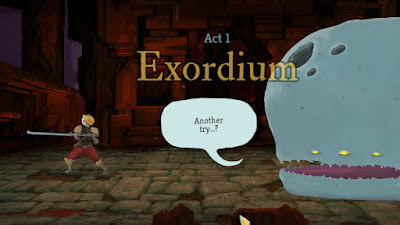
When it comes to Slay The Spire, this notion can be illustrated in the following way. If your goal is to get to the top of the Spire, that is not something that is wholly in your control. You have no idea which random cards, relics or bosses you will encounter, even if a thorough knowledge of the game might stop these from being a shock when they come. What you do have full control over however, is the goal that you want for yourself. If you set your goal as “I want to get as far up the Spire as I can, and not to give up even when things seem hopeless”, that is a very achievable aim. Even if you die to the first act boss, if you didn’t give up, you achieved your goal and can feel good about that.

Slay The Spire
You will see this screen a lot...

This is what I like about gaming in general, it gives us a chance to put into practise the character traits that we’d love to cultivate for other areas of our lives. You might like to add being patient and not letting frustration get the better of you too. You might not succeed at these 100% of the time, but if they are linked to a wiser overall goal of “seeing how far you can get”, even these slip-ups won’t feel so bad.

Something that I currently struggle with in Slay The Spire is being too hasty in my turn-taking, often realising that there was another card or potion that would have made a difference the split-second after I click the end turn button. Sometimes, I even end my turn and then notice that I still had enough energy to play one more card! So at the moment, while seeing how far I can get in each run, my intrinsic goal is to slow down and to give adequate time to finding solutions. Another thing that I’m prone to is fixating on a certain card build, whether or not I actually have the other cards to make it work. This often happens when a rare card comes into play and I take it, hoping that others that might support it will turn up later. Again, another goal is to not be dazzled by what's in front of me, to the extent that it makes me closed off to other possibilities. Slay The Spire is full of these little tests, and that’s why I love it.


The Stoic Test Frame


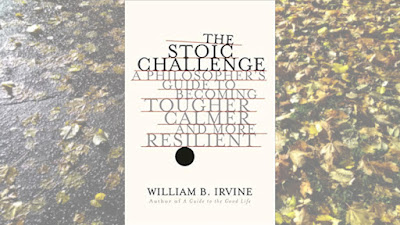
In another of William Irvine’s books: The Stoic Challenge, Irvine explains the value in meeting life’s obstacles and set-backs as a test from the Stoic gods. While you don’t need to believe in said gods, viewing things in this manner, as a challenge, can take some of the sting out of setbacks, and even add some fun into something that previously, you might have been despairing about. Irvine explains that a true setback has the element of surprise about it, but the ancient Stoics also engaged in toughness training, a process in which they deliberately put themselves into uncomfortable situations, in the hope of better dealing with setbacks when they popped up in other areas of life. Slay The Spire seems to have elements that are fitting for each approach, especially if you purposefully take the harder path or choice when the game presents you with one.

Slay The Spire
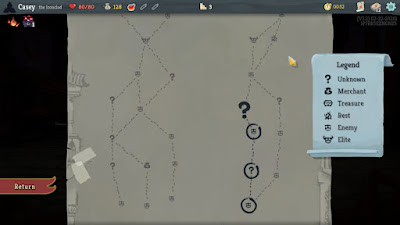
Which path to take?

A Slay The Spire setback that you have little control over might be that you are low in health and you decide to click on a mystery encounter, trying to avoid the certain monster fight that is your only other option. Once inside the room, you not only find that there are monsters inside, but that you are in a boss battle that you have no way of escaping. You die two turns later. You could rage and hiss your annoyance at the “stupid game”, and not learn anything from the experience. Or, you could notice the irritation that you feel, realise how unwarranted it is, and maybe even give a silent nod to the developers for crafting something so tricky and challenging. Your irritation is in response to something that you couldn’t control, and in realising this, you might give yourself a mental pat on the back as you chalk it up to experience. You might even feel pleased that you didn’t fuel your irritation until it blew up and ruined the rest of your gaming session. Same event, two different outlooks.

Video games seem to be the perfect arena to practise the Stoic Test Frame. After all, you already know that you’re playing a game, except in this instance, you are pitting yourself against the developer, possibly other human players, and, as in other areas of life, yourself. You only have to watch gaming content on YouTube or Twitch to see how games affect some players. There is a reason that the words “Rage” and “Tilt” and “Toxic” in video titles draw lots of clicks. If you want to see how to fail at building character, watch those videos. If you find that rare individual who seems to take setbacks in their stride with a smile and a more tranquil demeanour, enjoy their content and see how they frame things. You will more than likely find someone who loves rising to a challenge and who is also skilled at taking the sting out of what is happening by framing things in a beneficial way.

If you want to engage in some Stoic toughness training, you might even try playing Slay The Spire in a way that rubs against what you’d usually like to do. If you always grab certain cards or relics when they appear, you might like to have a run where you take cards or relics that you despise, or that go against your usual play style. If you prefer to keep your card-deck small, you might like to try accepting a card every time one is offered, letting you see what it is like to play with a massive assortment of cards. If you always avoid certain encounters or choices, forcing yourself to take them can be a wonderful way to learn something, and at the least, to get practise with some of the character traits that you want to nurture inside yourself. A video-game is the ideal, low-stakes place to try these kinds of experiments.
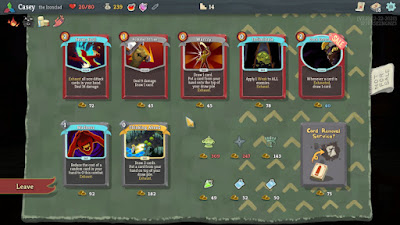

Slay The Spire
The shop in which many a build died due to temptation.

In Conclusion

I hope that I’ve done justice to the title of this post and have adequately explained why I find Slay The Spire to be so captivating. I’m sure that you can apply Stoic ideas to any game that you might play, but there is something about the turn-based, semi-random nature of Slay The Spire that seems conducive to having the space to breathe and to grow a little each time that you play it.

If you’d like to look into Stoicism a little more, you might like to read my review of William Irvine’s The Stoic Challenge, which is a book I very much recommend. I also recommend Donald Robertson’s How To Think Like A Roman Emperor, which illustrates many Stoic notions by depicting the life of Marcus Aurelius.
Thursday, 16 December 2021

Book Review: The Stoic Challenge

Book Review: The Stoic Challenge


Review By Casey Douglass


The Stoic Challenge


Sometimes, it can feel like life is full of setbacks. Whatever you try to do, things just seem stacked against you. It’s overwhelming. If like me, you have Obsessive Compulsive Disorder (OCD), you can probably multiply that feeling by a thousand or so. Then add one to the result for good measure. One of the elements of Stoic philosophy that most appeals to me is the notion of the Stoic Test, and William B. Irvine’s book The Stoic Challenge: A Philosopher's Guide to Becoming Tougher, Calmer, and More Resilient is firmly focussed on that particular approach.

Stoicism, as a philosophy, doesn’t entail suppressing emotions and keeping a stiff upper lip. That’s small “s” stoicism. Stoicism, the philosophy, takes a number of approaches in helping the practiser enjoy life just as it is. It does this by encouraging us to reflect on the things that are in, and beyond, our control, and living a life driven by values that aid us rather than harm us. Stoics still feel emotion, but they don’t needlessly fuel it by rumination. The practices they engage in also reduce the chance of negative emotion occurring.

William illustrates this nicely in the book with a burst water pipe analogy. The burst pipe, the setback, needs to be solved. The water that floods your house is your emotional reaction. Some water will leak, even if you are a super plumber who always has your tools at hand. Regardless, the sooner you can fix the pipe or stop the flow, the less damage the water will do to your home. If someone triggers anger in you (the burst pipe), you can either notice it and rise to the challenge, or you can lose your temper with them, stew all day, and flood your emotional basement. Using the Stoic Test approach is one way of dealing with this.

William explains that the Stoics purposefully adjusted how they framed events, to help bring their actions more into alignment with the virtues that they wanted to live by. An example of a re-framing that I always think of is that the sensations of anxiety and excitement are very similar, and how we view a particular arising depends on which frame we view said sensations through. That doesn’t mean in the midst of an OCD spiral, that I can suddenly decide to view it as exciting, but I get the concept if nothing else. Making use of the Stoic Test approach, for me, is more a reminder to at least recognise that things can be viewed differently.

To practise the Stoic Test frame, when you are confronted by a setback, you decide to frame it by saying that the Stoic Gods are sending you this challenge, for your own good, as a way to develop and grow. Now, you don’t need to believe that these Gods exist. You can even just imagine a sage-like elder standing nearby and prodding you towards the challenge. William emphasises that you need to bring this to mind as quickly as possible, preferably within five seconds of the first flush of frustration, anger or whatever is occurring, as it can stop the emotions running away with you. That’s about it. There are nuances and other helpful elements that William covers in the book, but that's the broad gist of things.

When I first started applying the Stoic Test frame to the setbacks I experienced, I was often slow in remembering to do so. I’d get a minute or two into some response and then remember it. Over time though, the notion came to mind more quickly. When it did, it genuinely seemed to help with how I viewed things. When I was able to apply it, it made setbacks seem almost amusing, or at the least, it felt fun to approach them as a challenge. I couldn’t do this all of the time, but it is slowly creeping into my world view the more that I do it. Things that trigger strong emotions are harder for me than more trifling setbacks, but as with anything, as the test frame becomes habitual, I don’t see why I couldn’t make headway with those too.

I had a nice example of a minor setback just before I started to redraft this review. I received an email coupon from a gaming website offering a discount. Often the coupons can’t be used if you’ve been a member before, but this one was titled in such a way that it suggested I could use it. What’s more, a game I have been interested in for awhile is included, so I was pleased at the idea of treating myself to a very cheap game. Well, the coupon couldn’t be used. It was the same as similar ones I’d been sent before after all, just titled in a misleading way. Within a few moments I reframed it as a Stoic Test and smiled. I did have a brief moment of wanting to tweet at the company to let them know that their coupon was misleading, but that urge soon fell away. Who cares. What’s more, the next day the company emailed and said that things didn’t quite go to plan, but now the coupon works as it should. It’s a low grade, low stakes example of how framing something differently takes some of the sting out of things. I wasn’t super upset, just mildly irked and disappointed. The fact that things resolved the next day in a favourable way was a pleasant surprise too, but if that hadn’t happened, I wouldn’t have minded.

With my OCD, I’m always careful not to buy into approaches that entail trying to control my emotions. This is counterproductive and just makes things worse. I like the Stoic Test frame approach as changing the frame just seems to encourage a softer, more accepting approach to things, without the emotional escalation that we often add to events ourselves. As the fear of setbacks in life, both large and small, is a major element of OCD, anything that can help me to view the world in a more tranquil and accepting way is just fine by me. If you have OCD, you might find the concept helpful to look into, but here, I can only speak as to how it has affected me.

The Stoic Challenge is a fine book that teaches the reader in a warm, friendly way. William illustrates his teachings with a variety of personal examples, and his easy going manner and acknowledgement that he still slips up, all make it a fantastic book. If you have any interest in Stoicism, or in how the way we view life can affect our mental health, I recommend this book. Also, if you have OCD and have yet to get any formal treatment, I’d do that first. I came to Stoicism after having CBT and other therapy, and I wouldn’t change that sequence of events for anything.


Book Title: The Stoic Challenge: A Philosopher's Guide to Becoming Tougher, Calmer, and More Resilient

Book Author: William B. Irvine

Publisher: W. W. Norton & Company

Current Price: £15.68 Hardback / £10.75 Paperback / £8.96 Kindle

ISBN: 978-0393652499

Published: 1 Oct 2019

Saturday, 13 March 2021

Book Review: How To Think Like A Roman Emperor

Book Review: How To Think Like A Roman Emperor


Review By Casey Douglass


How To Think Like A Roman Emperor


Of all the philosophies that I’ve encountered in my life, I think that Stoicism is the one that I’ve found most intriguing and useful. Sadly, as so many of the original Stoic writings have been lost to history, anyone who wants to learn about the philosophy has to ‘Sherlock Holmes’ their way through all sorts of fragments, letters and disjointed notes, with the odd actual book thrown in for good measure. Donald Robertson’s How To Think Like A Roman Emperor: The Stoic Philosophy of Marcus Aurelius, brings many Stoic principles and ideas together in one book, and what’s more, gives us plenty of examples of how Marcus Aurelius himself, likely put these into action in his efforts to live a wise and virtuous life.

Writing this a few days after finishing the book, I feel like I want to begin with how helpful it is that the book focussed on Marcus Aurelius and his life. Before reading How To Think Like A Roman Emperor, I’d read most of the ‘go to’ Stoic books, including Epictetus’ Discourses, Seneca’s Letters, and Marcus’ own Meditations. I’d also read some modern books on Stoicism, including Donald’s own Stoicism and the Art of Happiness. I tried to implement some of the Stoic techniques and perspectives that I encountered, into my own life, but I didn’t really feel that a great deal ‘stuck’.

The way that How To Think Like A Roman Emperor is anchored around Marcus Aurelius really seems to have provided the framework that I needed. Previously, I had a very vague idea of what Marcus Aurelius was like, besides a few notions about how good or virtuous he was meant to be. Now, thanks to Donald, I feel like I understand so much more. As an example, I didn’t realise that Marcus had an adoptive-brother and son-in-law called Lucius, and that, despite having a similar education in philosophy, they were two people who used that knowledge in vastly different ways, Lucius preferring to chase pleasure over almost anything else. This comes back so nicely to Donald’s introduction to the book.

On the last page of the introduction, Donald says that Stoicism can provide many tremendous things to your life, but warns that words on a page won’t achieve these changes, that only you can do that by putting the ideas into practise. Reading about Lucius and Marcus, their relationship and their actions, is such a fine example of this sentiment, and this leads me to other pleasing discoveries. One example is that I had no idea that the Stoics liked to hold up The Choice of Hercules as a moral fable of wisdom and virtue, in no small part due to the way that Hercules has to choose which path to take in life: that of Virtue or Vice. What seemed to make things even juicier for the Stoics, was that Hercules voluntarily chose the harder path, and had a much richer life for the effort. Epictetus tells his students that Hercules would never have become the Hercules they knew if he’d just stayed in bed!

Alongside the things that were new to me, there was also a liberal helping of Stoic ideas and techniques that I’d studied before. These included the explaining of the power that our judgements have in whether we are happy or miserable, and the usefulness of the Stoic Reserve Clause in helping us to accept that the outcomes of so many of the things we attempt aren’t wholly up to us, among many other helpful ideas. Donald also uses his psychology ‘chops’ and brings some elements of Cognitive Behavioural Therapy (CBT) into things, which he says seems fitting, considering that CBT was itself inspired by Stoicism.

I really enjoyed this melding of the Stoic philosophy with the modern therapy that more people might actually be familiar with. I was taught about CBT decades before I’d even heard of Stoicism. This was during the initial treatment of my Obsessive Compulsive Disorder and it was nice to read a book that highlights some of the overlap between the two systems. As with many things though, the situation and the time in which you find yourself reading a book often informs what might jump out at you, or which information you might find most useful. So what did I get out of my first journey through How To Think Like A Roman Emperor?

To recap, I feel that the main thing I got out of it was having a more fleshed out idea of who Marcus Aurelius really was, and this helped me in a number of snow-balling ways. When it comes to some of the practises that entail asking yourself how someone like Marcus might respond to a situation, I now feel that I can do that with a little more insight. Before, the only Marcus that I could think of when pondering that question was Marcus Burnett, Martin Laurence’s character in the Bad Boys films. I think ‘Bad Boys Marcus’ would have just started swearing and freaking out, which doesn’t seem like a sustainable path to improving your life.

I have also adopted a number of the practises in the book, practises that I had already encountered before but had failed to follow through with. These include meditating on the day ahead when I wake in the morning, trying to be mindful during the day, and reviewing how my day went before going to sleep at night, to see how I could have responded to things in a way that is more aligned with my virtues or values. I’ve also started to become more aware of the value Stoics put in speaking plainly, describing things with less emotion and avoiding rhetoric, which in the age of social media and click-bait news stories, seems timely advice indeed. The number of occasions that I have seen something described as ‘catastrophic’ or ‘devastating’, and then see that the person saying these things is rarely directly affected by whichever event they are commenting on... It’s no wonder social media is often so febrile.

I recommend How To Think Like A Roman Emperor to anyone who would like to learn more about Stoic philosophy and/or Marcus Aurelius. My only regret is that this wasn’t the first book I read on the subject, as it really did hit the nail on the head for me. It also appears that Donald is working on a Marcus Aurelius graphic novel, which is something I’d be very interested in seeing!


Book Title: How To Think Like A Roman Emperor

Book Author: Donald Robertson

Publisher: St. Martin’s Griffin

Released: 2 April 2019

Current Price (Amazon UK): £16.32 (Hard-cover), £6.43 (Paperback). £5.83 (Kindle)

ISBN: 978-1250196620