Showing posts with label Stoic Philosophy. Show all posts

Friday, 23 June 2023

Stoicism: Stoa App Review

Stoicism: Stoa App Review


Review by Casey Douglass


Stoa App


The philosophy of Stoicism gained its name by being taught on the “painted porch”, or stoa, in ancient Greece. It was a philosophy very much of the people, and its street-side nature was as open a way as any for passers-by to have their interest piqued. Stoa is a smartphone app that aims to bring Stoicism to our modern “digital streets”, in the hope that many more people might experience the benefits of the mindful Stoic outlook on life.

I won’t go too in-depth about what Stoicism is, save to say that the Stoic philosophy is very different to being small “s” stoic. The first is aware of the role that our value judgements play in everyday life, those things that we label as good or bad, and the way that these judgements affect our emotions. A Stoic wants to develop their character and to live well in the world. The latter tries to hide all external expression of certain emotions, and more than likely tries to repress them so that they don’t even feel them. The first is wise. The latter is a breakdown (or a meltdown) waiting to happen.


Stoa App Courses
A brief look at some of the courses

Stoa gives the user access to a whole host of meditations and teachings from the ancient Stoics, and it does this by letting the user digest concepts in small, manageable routines. Each day, the main page of Stoa will present your current lesson, broken down into a number of sections: A quote, the theory behind it, a meditation practice incorporating this idea, an invitation to make a commitment to practise, and a chance to note if you followed through. I really appreciated this layout, as often, any internal resistance towards starting the daily lesson was soon banished by even just reading the quote, a micro-action that takes all of a few seconds.

When I first started to explore the Stoa app, I also happened to slip into a severe period of depression (unrelated to using the app). Even though I’ve read about, and attempted to practise, Stoic philosophy for a decent number of years now, I still found myself struggling to muster the motivation to even look inside the app. This is where each lesson being broken down into tiny steps really helped, as I just tried to read the quote each day. Some days, once I’d read the quote, I saw that the theory audio was so short (often only a few minutes) that I thought I’d listen to that too. After this, I was almost half way through the lesson, although I often stopped when I got to the meditation section, as at the time, I couldn’t cope with some of those.


Stoa App Main Page
The Stoa App main page

The meditations are really well done and helpfully give the listener some guidance with how to reflect on and digest the notions of the day. I did enjoy the more mindfulness-based ones but during my dip into depression, I found a good number of the meditations included elements that required me to think about a problem and to visualise it in a new way, such as how I’d most like to respond. This is valuable advice and direction but I just couldn’t do it while depressed; my mind couldn’t even grasp some of the concepts that I already knew at that point. I was just content to read my quote and listen to my lesson of the day.

When using Stoa, you aren’t restricted to the lesson of the day, there are all manner of other audio and written resources in the app. You can delve into various elements of Stoic theory, learn about the lives of the most well-known Stoics, such as Marcus Aurelius and Epictetus, and even listen to some brilliant conversations about Stoic topics, conducted between the Stoa team, or with other experts in the field. You can access some of these conversations at Stoa Conversations. I really valued listening to these conversations as they often branched out into other areas of life, such as creativity, how to deal with bullying, and with fake news. A good chunk of my “minutes” shown below came from listening to the podcasts.

Stoa App Streak
My best month regarding my "streak"

Stoa was created by Caleb Ontiveros and Michael Tremblay, two philosophy lovers who have come together to spread a little more Stoic wisdom in the world. While there are already some excellent books that break Stoic ideas down into day-sized chunks, Stoa really benefits from its digital form and the way that we nearly always have our smartphones close at hand. The mild gamification (streak counting) and the low-effort positive psychological principles in the app design (such as pressing a button to commit to your practice) all create a feeling of progressing, without hitting you over the head with too much. Stoicism is, after all, a life-long process, where repeated visits to a topic, with many periods of reflection, is usually needed to get said topic to travel from “head to heart” so to speak. From mere thought to knowing. Stoa makes this a pleasing, interesting experience and, even if I don’t keep those streaks going, I know it’s an app that I will return to again and again.

You can find out more information about Stoa on the website. Pricing details are below, and also links to the Apple and Google app stores. If you are interested in the app and genuinely can't afford it, you can also get in touch with Stoa who will give you a free account. You can find details about this on their website.


I was given free access to this app for review purposes


App Name: Stoa

Developer: Zeno Apps LLC

Platforms: Apple App Store & Google Play Store

Price: Free 7 day trial, then £8.99 / $9.99 per month or £46.99 / $69.99 per year.

Tuesday, 12 July 2022

Book Review: Verissimus: The Stoic Philosophy of Marcus Aurelius

Book Review: Verissimus: The Stoic Philosophy of Marcus Aurelius


Review By Casey Douglass


Verissimus Cover


Just over three years ago, Donald Robertson’s How To Think Like A Roman Emperor released, a book that taught the reader about Stoic philosophy by way of describing the life of one of its greatest adherents: Marcus Aurelius. Donald’s latest book Verissimus: The Stoic Philosophy of Marcus Aurelius sees him teaming up with illustrator Zé Nuno Fraga to depict the philosophical journey of Marcus Aurelius in a new, eye-catching graphic novel format.

You’ve probably heard the name of Marcus Aurelius, but you might not know much about him. Marcus was one of the most famous ancient Stoics, one that also became the most powerful man in the known world when he took up the position of Roman emperor. Even though he showed unusual promise as a truthful and remarkably wise child, Marcus still had to work hard at developing his character, living wisely, and juggling the massive demands put upon him as ruler. He wrote his own book The Meditations to help with his efforts to keep himself on course.


Verissimus
Marcus being advised to embody his philosophy, rather than simply appearing to live it.

Verissimus begins with Marcus on his deathbed, dying of the plague. He is being attended to by his physician, his family and his closest advisors. The very first image is of Marcus alone, in an incense clouded room. When I reached this page, I was a little startled after I realised how long I’d been looking at the scene. It seemed lonely, yet peaceful. Serious, yet expected. The ‘expected’ part solidifies as Marcus’ thinks and interacts with those who visit. He has been expecting this for so long, he has no fear of death. He sees it as a process of nature, and nothing natural needs to be feared. This is a great foreshadowing of the Stoic idea of ‘living according to nature’ and is something that we get to witness as Marcus’ life story unfolds.

Verissimus is split into fourteen sections, each touching on an important element or period in Marcus’ life. The reader gets to see him as a young child, particularly how he is tutored and raised. We get to see his love of philosophy and his aversion to becoming emperor. Once emperor, Marcus has to deal with war, plague and politics, alongside his own familial troubles and tragedies. I particularly enjoyed seeing the relationship that he had with his brother and co-emperor Lucius, as Marcus and he have such different characters, that it really helps to emphasise how different Marcus was from what was ‘normal’ for the time. Another element that I was glad to see in the graphic novel was Apollonius the Stoic’s relating of the choice of Hercules, a tale that tells of when Hercules has to choose between an easy life, or one of excellence and virtue. There are many other fascinating moments to feast your eyes upon, but I’m happy to see that the events that most surprised or stuck with me from How To Think Like A Roman Emperor made it across.


Verissimus
The beginning of the Hercules story. 

In the preface, Donald points out that Verissimus isn’t intended to be an introduction to Stoic philosophy, but a way to depict the ways in which Marcus Aurelius actually lived his philosophical beliefs. Donald says that his previous books, such as How To Think Like A Roman Emperor, are hopefully more apt as an introduction to Stoicism. If you are new to Stoicism or Marcus Aurelius, Verissimus is a tremendous way to begin to learn about both. If it really tickles your fancy and you want to read more in-depth information, you can then jump into How To Think Like A Roman Emperor for even more details, alongside comparisons with some aspects of modern therapy and how it sometimes uses similar approaches to the Stoics.

What about if you are coming to Verissimus after having read other Stoic works, particularly How To Think Like A Roman Emperor, such as in my own case? Will seeing Marcus’ life in graphic novel form bring anything new for you? I think that Donald sums up the power of the imagery best in his afterword. After seeing Marcus’ son Commodus depicted in visual form, Donald says that he began to view him in a somewhat different way. Donald has spent around twenty five years researching these topics. For a change of media to show him something differently in his own work... I think that’s more than a testament to the quality of the illustration and the power of Verissimus as a graphic novel. Personally, I feel that the imagery brings the life of Marcus, and various elements of Stoic philosophy, into a rich and vibrant level of clarity, and it does this in a way that’s as enjoyable as it is educational.


Verissimus
A Stoic lesson on indifference and our automatic reactions.

Visit the Verissimus page at this link for more information, or copy and paste the ISBN below into your book website of choice.

If you'd like to read my review of Donald's How To Think Like A Roman Emperor, you can find that at this link.

Thank you to St. Martin’s Press for sending me an advance review copy of the book.


Book Title: Verissimus: The Stoic Philosophy of Marcus Aurelius

Book Author: Donald Robertson

Book Illustrator: Zé Nuno Fraga

Publisher: St. Martin’s Press

ISBN: 9781250270955

RRP: $32.50 U.S / £25 U.K (hard-cover)

Releases: 12 July 2022 U.S / 19 July 2022 U.K (hard-cover)

Thursday, 16 December 2021

Book Review: The Stoic Challenge

Book Review: The Stoic Challenge


Review By Casey Douglass


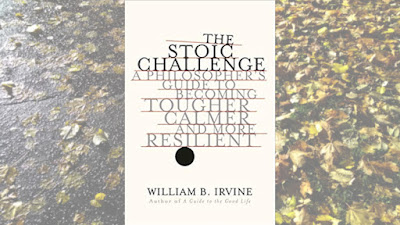
The Stoic Challenge


Sometimes, it can feel like life is full of setbacks. Whatever you try to do, things just seem stacked against you. It’s overwhelming. If like me, you have Obsessive Compulsive Disorder (OCD), you can probably multiply that feeling by a thousand or so. Then add one to the result for good measure. One of the elements of Stoic philosophy that most appeals to me is the notion of the Stoic Test, and William B. Irvine’s book The Stoic Challenge: A Philosopher's Guide to Becoming Tougher, Calmer, and More Resilient is firmly focussed on that particular approach.

Stoicism, as a philosophy, doesn’t entail suppressing emotions and keeping a stiff upper lip. That’s small “s” stoicism. Stoicism, the philosophy, takes a number of approaches in helping the practiser enjoy life just as it is. It does this by encouraging us to reflect on the things that are in, and beyond, our control, and living a life driven by values that aid us rather than harm us. Stoics still feel emotion, but they don’t needlessly fuel it by rumination. The practices they engage in also reduce the chance of negative emotion occurring.

William illustrates this nicely in the book with a burst water pipe analogy. The burst pipe, the setback, needs to be solved. The water that floods your house is your emotional reaction. Some water will leak, even if you are a super plumber who always has your tools at hand. Regardless, the sooner you can fix the pipe or stop the flow, the less damage the water will do to your home. If someone triggers anger in you (the burst pipe), you can either notice it and rise to the challenge, or you can lose your temper with them, stew all day, and flood your emotional basement. Using the Stoic Test approach is one way of dealing with this.

William explains that the Stoics purposefully adjusted how they framed events, to help bring their actions more into alignment with the virtues that they wanted to live by. An example of a re-framing that I always think of is that the sensations of anxiety and excitement are very similar, and how we view a particular arising depends on which frame we view said sensations through. That doesn’t mean in the midst of an OCD spiral, that I can suddenly decide to view it as exciting, but I get the concept if nothing else. Making use of the Stoic Test approach, for me, is more a reminder to at least recognise that things can be viewed differently.

To practise the Stoic Test frame, when you are confronted by a setback, you decide to frame it by saying that the Stoic Gods are sending you this challenge, for your own good, as a way to develop and grow. Now, you don’t need to believe that these Gods exist. You can even just imagine a sage-like elder standing nearby and prodding you towards the challenge. William emphasises that you need to bring this to mind as quickly as possible, preferably within five seconds of the first flush of frustration, anger or whatever is occurring, as it can stop the emotions running away with you. That’s about it. There are nuances and other helpful elements that William covers in the book, but that's the broad gist of things.

When I first started applying the Stoic Test frame to the setbacks I experienced, I was often slow in remembering to do so. I’d get a minute or two into some response and then remember it. Over time though, the notion came to mind more quickly. When it did, it genuinely seemed to help with how I viewed things. When I was able to apply it, it made setbacks seem almost amusing, or at the least, it felt fun to approach them as a challenge. I couldn’t do this all of the time, but it is slowly creeping into my world view the more that I do it. Things that trigger strong emotions are harder for me than more trifling setbacks, but as with anything, as the test frame becomes habitual, I don’t see why I couldn’t make headway with those too.

I had a nice example of a minor setback just before I started to redraft this review. I received an email coupon from a gaming website offering a discount. Often the coupons can’t be used if you’ve been a member before, but this one was titled in such a way that it suggested I could use it. What’s more, a game I have been interested in for awhile is included, so I was pleased at the idea of treating myself to a very cheap game. Well, the coupon couldn’t be used. It was the same as similar ones I’d been sent before after all, just titled in a misleading way. Within a few moments I reframed it as a Stoic Test and smiled. I did have a brief moment of wanting to tweet at the company to let them know that their coupon was misleading, but that urge soon fell away. Who cares. What’s more, the next day the company emailed and said that things didn’t quite go to plan, but now the coupon works as it should. It’s a low grade, low stakes example of how framing something differently takes some of the sting out of things. I wasn’t super upset, just mildly irked and disappointed. The fact that things resolved the next day in a favourable way was a pleasant surprise too, but if that hadn’t happened, I wouldn’t have minded.

With my OCD, I’m always careful not to buy into approaches that entail trying to control my emotions. This is counterproductive and just makes things worse. I like the Stoic Test frame approach as changing the frame just seems to encourage a softer, more accepting approach to things, without the emotional escalation that we often add to events ourselves. As the fear of setbacks in life, both large and small, is a major element of OCD, anything that can help me to view the world in a more tranquil and accepting way is just fine by me. If you have OCD, you might find the concept helpful to look into, but here, I can only speak as to how it has affected me.

The Stoic Challenge is a fine book that teaches the reader in a warm, friendly way. William illustrates his teachings with a variety of personal examples, and his easy going manner and acknowledgement that he still slips up, all make it a fantastic book. If you have any interest in Stoicism, or in how the way we view life can affect our mental health, I recommend this book. Also, if you have OCD and have yet to get any formal treatment, I’d do that first. I came to Stoicism after having CBT and other therapy, and I wouldn’t change that sequence of events for anything.


Book Title: The Stoic Challenge: A Philosopher's Guide to Becoming Tougher, Calmer, and More Resilient

Book Author: William B. Irvine

Publisher: W. W. Norton & Company

Current Price: £15.68 Hardback / £10.75 Paperback / £8.96 Kindle

ISBN: 978-0393652499

Published: 1 Oct 2019

Monday, 23 August 2021

Dark Ambient Review: Mithra

Dark Ambient Review: Mithra


Review By Casey Douglass


Mithra Album Art

It’s a real pity that we can’t hop in, on, or don our own time machine and flit back in time to the periods that interest us. Actually, knowing humans, it’s probably a damn good thing that we can’t. We always seem to want to rewrite history in a purely mental fashion, the damage we’d cause if we could actually go back would probably be apocalyptic. Music is safer. Ager Sonus’ Mithra is a dark ambient, atmospheric journey back to the time of Rome, and to the time of the Cult of Mithras.

Mithra is an album that is very strong on the instrumental front. There are piano notes, strings and horns, to name but a few. There are also plenty of instances of environmental sounds and drones, delicate plucked string notes often sitting easily with the sound of the wind, or the quietly echoing dripping of water. The eight tracks of the album are all pretty smooth and chilled. Mithra feels like the quintessential album to listen to by cosy firelight.

Beneath is one of the tracks that most appealed to me. It opens with a low drone and a vocal-like resonance. The soundscape has the dripping, echoing aesthetic of a cave, with new tones and quiet pipe-like notes emerging as the track progresses. There are swells of pulsing tone, and at some points, a kind of “laughing” feeling suggested itself to me, like something malignant in the atmosphere chuckling at the audacity of humans. This felt like a lovely dark track to me, one of delving into the earth and into a different realm.

Ritual is another track that evoked similar feelings. This track starts with an echoing chiming and what sounds like distant, ghostly vocals. There are string notes, shimmering cymbals and a deep, slow drumbeat. This track felt like it was full of chittering shadows. It’s the kind of track that would accompany someone as they walk into a dark cavern, flaming torch held aloft, strange air currents carrying the distant scent of incense and dark workings to the explorer. Exploration and darkness is a heady mixture.

Mithra wasn’t all darkness and creepiness though. Dawn is a much lighter track, and one that I enjoyed for different reasons. It begins with low string tones and a relaxed piano melody. There is the sound of the wind and a bird chirping. There are footsteps lightly crunching through grass or leaves, a warbling, horn-like tone and a sparkling quality to the soundscape. This, unsurprisingly, felt like seeing the golden sunlight of dawn bathing a peaceful landscape in warm, soft light. The soundscape does have undercurrents of things twisting later on, notes and tones that create a feeling of things not being as idyllic as they appear. I enjoyed this track for this very reason, as things are never wholly good or bad, lucky or unlucky, in my opinion at least.

Mithra is a peaceful dark ambient album, one that takes the listener into landscapes and scenes of yore, mixing in the light and the dark elements in a pleasing ratio and manner. It has a dream-like, magical quality, and also the feeling of antiquity. On a personal note, I also enjoyed that it led my mind to pondering the concepts of Stoic philosophy, Marcus Aurelius etc. as this would also have been around at about the same period as the Cult of Mithras, as far as I’m aware. A very fine album.

Visit the Mithra page on Bandcamp for more information. You can check out the track Ritual below: 


I was given a review copy of this album.


Album Title: Mithra

Album Artist: Ager Sonus

Label: Cryo Chamber

Released: 26 March 2019

Saturday, 13 March 2021

Book Review: How To Think Like A Roman Emperor

Book Review: How To Think Like A Roman Emperor


Review By Casey Douglass


How To Think Like A Roman Emperor


Of all the philosophies that I’ve encountered in my life, I think that Stoicism is the one that I’ve found most intriguing and useful. Sadly, as so many of the original Stoic writings have been lost to history, anyone who wants to learn about the philosophy has to ‘Sherlock Holmes’ their way through all sorts of fragments, letters and disjointed notes, with the odd actual book thrown in for good measure. Donald Robertson’s How To Think Like A Roman Emperor: The Stoic Philosophy of Marcus Aurelius, brings many Stoic principles and ideas together in one book, and what’s more, gives us plenty of examples of how Marcus Aurelius himself, likely put these into action in his efforts to live a wise and virtuous life.

Writing this a few days after finishing the book, I feel like I want to begin with how helpful it is that the book focussed on Marcus Aurelius and his life. Before reading How To Think Like A Roman Emperor, I’d read most of the ‘go to’ Stoic books, including Epictetus’ Discourses, Seneca’s Letters, and Marcus’ own Meditations. I’d also read some modern books on Stoicism, including Donald’s own Stoicism and the Art of Happiness. I tried to implement some of the Stoic techniques and perspectives that I encountered, into my own life, but I didn’t really feel that a great deal ‘stuck’.

The way that How To Think Like A Roman Emperor is anchored around Marcus Aurelius really seems to have provided the framework that I needed. Previously, I had a very vague idea of what Marcus Aurelius was like, besides a few notions about how good or virtuous he was meant to be. Now, thanks to Donald, I feel like I understand so much more. As an example, I didn’t realise that Marcus had an adoptive-brother and son-in-law called Lucius, and that, despite having a similar education in philosophy, they were two people who used that knowledge in vastly different ways, Lucius preferring to chase pleasure over almost anything else. This comes back so nicely to Donald’s introduction to the book.

On the last page of the introduction, Donald says that Stoicism can provide many tremendous things to your life, but warns that words on a page won’t achieve these changes, that only you can do that by putting the ideas into practise. Reading about Lucius and Marcus, their relationship and their actions, is such a fine example of this sentiment, and this leads me to other pleasing discoveries. One example is that I had no idea that the Stoics liked to hold up The Choice of Hercules as a moral fable of wisdom and virtue, in no small part due to the way that Hercules has to choose which path to take in life: that of Virtue or Vice. What seemed to make things even juicier for the Stoics, was that Hercules voluntarily chose the harder path, and had a much richer life for the effort. Epictetus tells his students that Hercules would never have become the Hercules they knew if he’d just stayed in bed!

Alongside the things that were new to me, there was also a liberal helping of Stoic ideas and techniques that I’d studied before. These included the explaining of the power that our judgements have in whether we are happy or miserable, and the usefulness of the Stoic Reserve Clause in helping us to accept that the outcomes of so many of the things we attempt aren’t wholly up to us, among many other helpful ideas. Donald also uses his psychology ‘chops’ and brings some elements of Cognitive Behavioural Therapy (CBT) into things, which he says seems fitting, considering that CBT was itself inspired by Stoicism.

I really enjoyed this melding of the Stoic philosophy with the modern therapy that more people might actually be familiar with. I was taught about CBT decades before I’d even heard of Stoicism. This was during the initial treatment of my Obsessive Compulsive Disorder and it was nice to read a book that highlights some of the overlap between the two systems. As with many things though, the situation and the time in which you find yourself reading a book often informs what might jump out at you, or which information you might find most useful. So what did I get out of my first journey through How To Think Like A Roman Emperor?

To recap, I feel that the main thing I got out of it was having a more fleshed out idea of who Marcus Aurelius really was, and this helped me in a number of snow-balling ways. When it comes to some of the practises that entail asking yourself how someone like Marcus might respond to a situation, I now feel that I can do that with a little more insight. Before, the only Marcus that I could think of when pondering that question was Marcus Burnett, Martin Laurence’s character in the Bad Boys films. I think ‘Bad Boys Marcus’ would have just started swearing and freaking out, which doesn’t seem like a sustainable path to improving your life.

I have also adopted a number of the practises in the book, practises that I had already encountered before but had failed to follow through with. These include meditating on the day ahead when I wake in the morning, trying to be mindful during the day, and reviewing how my day went before going to sleep at night, to see how I could have responded to things in a way that is more aligned with my virtues or values. I’ve also started to become more aware of the value Stoics put in speaking plainly, describing things with less emotion and avoiding rhetoric, which in the age of social media and click-bait news stories, seems timely advice indeed. The number of occasions that I have seen something described as ‘catastrophic’ or ‘devastating’, and then see that the person saying these things is rarely directly affected by whichever event they are commenting on... It’s no wonder social media is often so febrile.

I recommend How To Think Like A Roman Emperor to anyone who would like to learn more about Stoic philosophy and/or Marcus Aurelius. My only regret is that this wasn’t the first book I read on the subject, as it really did hit the nail on the head for me. It also appears that Donald is working on a Marcus Aurelius graphic novel, which is something I’d be very interested in seeing!


Book Title: How To Think Like A Roman Emperor

Book Author: Donald Robertson

Publisher: St. Martin’s Griffin

Released: 2 April 2019

Current Price (Amazon UK): £16.32 (Hard-cover), £6.43 (Paperback). £5.83 (Kindle)

ISBN: 978-1250196620