Showing posts with label Electronic. Show all posts

Wednesday, 28 June 2023

Dark Ambient Review: The Curse of Spring-Heeled Jack

Dark Ambient Review: The Curse of Spring-Heeled Jack


Review By Casey Douglass


The Curse of Spring-Heeled Jack Art


It’s funny how the ghouls and spectres from the non-digital past seem to be all that much more mysterious and sinister for it. The fog of hand-me-down memories and the way that we always think that we know better than our more “simple” or less “enlightened” ancestors creates a strange kind of grittiness to the topic, an almost feral air of interest. For The Curse of Spring-Heeled Jack, criptid corraller and myth master Mombi Yuleman has turned his attention to the bouncy and sinister Victorian folklore of Spring-Heeled Jack.

Spring-Heeled Jack was the name that society bestowed on the perpetrator of a number of mysterious attacks in Victorian Britain, his most popularised characteristic being his ability to jump to great heights. He was also apparently of a sinister aspect, and at the time, set imaginations and hearts racing. Mombi’s musical style of bouncy electronic notes and rhythms lends itself so well to this subject matter, and from the very first track, this smoke-laden, industrial slab of British history jiggles and jounces into the listener’s lugs.

The opening track, Hammersmith 1837, does a great job of setting the scene and feel of the album. A bubbling, clock-ticking, bell-like opening produces bouncy notes and melodies, backed by choral swells, organ tones and guitar chugging. For me, this track had “chase music” written all over it, and I had a pleasing mental impression of Victorian London at midnight, pale moonlight illuminating chimney smoke, and the fleeting shadow that happens to be bounding from rooftop to rooftop. The latter half of the track features a kind of whirling, helicopter “whup-ping” sound which greatly aids in this mental image. A fun but also sinister track.

Another track that really stood out for me is Jack be Nimble, Jack be Quick. Sitting at just under three minutes long, it opens with a mechanical, hissing, factory-like environment. Twisting plucked notes and a bulbous deep tone sit in the soundscape alongside a knocking beat and sounds of activity. A ghostly chorus emerges with a squelchy melody, and then, manic laugher backed by what sounds like a hammer hitting an anvil. This is another track that suggested the notion of being chased to me. Maybe Spring-Heeled Jack is trying to evade capture by bounding through an active foundry?

The Devil’s Footprints follows, and begins with a warped clockwork knocking rhythm. It’s a fuzzy track, but one that features a gnat-like melody that really buzzes into your mind. This track had a melancholy or at the least, a more peaceful feel. Maybe this track is depicting the carnage left in Jack’s wake, the common city-dwelling folk waking up and finding bloodstains outside of their homes. A really enjoyable track and a different kind of mood, although that mood does shift slightly as the track approaches its conclusion.

I briefly wanted to mention two more tracks that grabbed me. I enjoyed Exploits at the Astronomical Clock for its “heist movie” feel, particularly when the string-like notes emerge in the latter half. Terrorizing the SS also really comes to mind as a great track that would sit well behind a newspaper headline montage in a movie, the escalating headlines backed by its blend of stabby notes and darting strings. They both have the urgent feeling of “things happening”, which is something that I enjoyed.

The Curse of Spring-Heeled Jack struck me in a very “filmic” way, the visual impressions and movie angles that I seem to have pondered only something that I noticed when writing this review. This is to Mombi’s credit of course, and shows why he chose “soundtrack” as one of the tags for this album on Bandcamp. The album is full of fast, bouncy, and often jaunty melodies, but all backed with that twisting, creeping weirdness that Mombi is so good at injecting. As in his previous album Witch-Works, and others, Mombi has brought the Halloween-type spirit to a dark piece of British folklore. If you enjoy forteana with a light-hearted yet sinister aspect, you’d do well to check out The Curse of Spring-Heeled Jack.

P.S You might also like to check out Mark Hodder’s Burton and Swinburne series of books, the first of which is called The Strange Affair of Spring Heeled Jack, an excellent steampunk alternate history saga that I read some years ago.

Visit the The Curse of Spring-Heeled Jack page on Bandcamp for more information.


I was given a review copy of this album.


Album Title: The Curse of Spring-Heeled Jack

Album Artist: Mombi Yuleman

Released: Feb 3, 2023

Tuesday, 3 May 2022

Dark Ambient Interview: Jan Robbe

Dark Ambient Interview: Jan Robbe


Jan Robbe

Jan Robbe is a composer, programmer, artist and sound designer, one with a love of broken rhythms, experimental electronic soundscapes, and the possibilities afforded by using technology in the creative process. Along with co-founding the netlabel Entity, Jan has various music projects to his name including UndaCova, Atomhead, Duncan Avoid and Diagnostic, the last of which is how we began chatting.

In this interview, Jan reveals how he got started with the tracker scene back in the 90s, the perils of getting stuck in one type of creative style, and who his inspirations are. He also tells us which software and hardware he likes to utilise, how he uses neural networks as an aid to his creations, and why he thinks that humans using A.I for creativity is a dance that benefits us greatly.


* * *


Casey: The description of the latest album under your Diagnostic name, Morphology, tells the listener that you utilised things such as non-linear feedback loops and neural networks, among other approaches, when you created this album. Before we get to that though, in the 90’s, you experimented with tracker software on hardware that was far less powerful than that which is available today. What brought the young Jan Robbe to music creation, and what sort of software and hardware were you using back then?

Jan: Back then my interest in music creation coincided with the discovery of the tracker scene. Simply searching for free music on the internet, that was also small in download size (actually a factor at that time) led me to the Fasttracker / Impulse Tracker software that many artists were using. I remember being shocked by how good the music actually was, even though netlabels were putting it online for free, it was a true explosion of creativity.

So I used Fasttracker at first, but my music wasn't very good. It wasn't until Fruityloops came along, with the support of VST plugins, that things really got interesting. I understood that I didn't actually need to buy any sophisticated hardware to make pleasing sounds, in fact it was all pretty much free of charge.

Around 1999 was when I really caught the producing bug and decided I would make a track every day, with the sole mission of making something that I could be proud of, and perhaps also something that others would enjoy.


Casey: Committing to creating a track every day and doing it for the intrinsic feeling of satisfaction are both great ways to go about any sort of creative endeavour. Have there been periods where you fell out of love with the music or the process, for whatever reason, and are there any other mental approaches or techniques that you use to help to get yourself back on track?

Jan: Especially in the very beginning there were several moments where I simply gave up. It takes a lot of time to grasp all the concepts (synthesis, mixing, compression, fx, ...), but my love for music has always brought me back. By now it's my preferred creative outlet, I almost need it to feel sane, to catch emotional unease by the throat. Or simply for my own enjoyment.

There have been periods where I just lacked the time or inspiration, but I keep in mind that these are only temporary. Life gets in the way since it's never been a sustainable thing for me. Getting stuck in a singular style has also proven to be a problem, but changing up, learning new styles is just endless fun. There's always some artist that will inspire me to make something new.


Casey: Who were some of your biggest influences and inspirations when it came to the music that you wanted to create, and how might this have led to you co-founding the Entity website?

Jan: I remember feeling bothered with commercial electronic music being very repetitive and similar. There was a clear opportunity to just break things, you know, like broken rhythms, breakbeats, but not as a looping structure... I wanted it to just keep on breaking itself with endless variation. Aphex Twin seemed like one of the first to really execute this idea properly, with Squarepusher and Autechre working in parallel and really pushing the boundary of sound. Along came Venetian Snares, which really spoke to me as I always preferred the harder side of music.

But you know, life isn't all metal and violence, so in that regard, say around 2002, I found my counterpart in ambient and more specifically, dark ambient / drone music, just to cover a wider emotional spectrum, using music as therapy.

In 2003, with my friend Nico, we started a website to promote the experimental approach in electronic music. Something that wasn't genre-bound, but simply sounding good to our ears with the artists' authenticity shining through: Entity. This way we got to really know and discover artists, work with them and help them reach some listeners, however small the audience, it didn't matter much as we felt connected in our cause. We all know we are an odd bunch anyway.

Fast forward to today, the list of artists I appreciate just keeps on growing. In my current playlist there's KK Null, SØS Gunver Ryberg, Fernanda Martins, Alphaxone, ProtoU, Marco Monfardini, Oophoi and Ionosphere to name a few.


Casey: As with so much in the music world, the technological world has advanced a great deal in a few short decades. What have been some of the most exciting tools for you to use during that time, and what does your current composing/creation environment include?

Jan: Along came things like Native Instruments Reaktor, Absynth and granular synths (most notably the native Granulizer in FLStudio and Robert Henke's Granulator) which really took sampling to the next level. In later Atomhead works I got a bit obsessed with Rob Papen's Subboombass which served as the basis for a lot of my drums / bass sequences. UHE Bazille became my go-to modular emulator, and eventually got me into the analog modular domain.

For a couple of years now I've collected Eurorack modules and experimented with them, and while there is certainly a uniqueness to this approach, and improvisation is very gratifying, I find myself returning to the digital domain since I see myself more as a composer / programmer / sound designer than a performer.
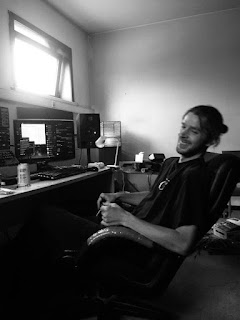
Jan relaxing while sat at his studio

Casey: For Morphology, you made use of machine learning to create the sounds it contains. What need does machine learning fulfil in your creative process, and how do you train the neural network to give you output that is in the ballpark of what you are looking for... Or do you use it more as an element of chaos and let it throw up things for you to spring off from?

Jan: I've always had an interest in how the brain works, how we perceive music and sound, so when the opportunity arises to experiment I gladly jump on the train. A.I is an important evolution, of which we are only scratching the surface. It is evolving at an enormous pace, it's actually hard to keep up, but using Google Colab's cloud computing service it became more convenient as some of the notebooks are easier to grasp and don't require an advanced degree in programming to use.

Using the Jukebox AI notebooks, there are a couple ways to go about it. One method is to prompt it with a piece of music, and have it "guess" what the continuation might be, based on a large pre-trained database of music or "model". When you are in a creative rut, it's obvious how this output could be used to your advantage since the results are entirely unpredictable.

For Morphology I found it more apt to train my own neural network, based on the material that I had already created, in order for it to produce variations of itself. Most of the time it tends to output a mess of unintelligible garble. But once in a while, something entirely unique comes out of it, something that also displays actual emotive content, that I wouldn't have created myself, though it still contains the gist of the sources so it would "fit" with the rest.


Casey: The other element mentioned in the description of Morphology is chaos, by way of non-linear feedback loops. I’d imagine that your neural network’s output produced plenty of chaos that also made it into the track. How important was it for you to have some chaos in Morphology, why does it appeal to you, and why are non-linear feedback loops a fine place to find it?

Jan: Chaos is not just a kind of randomness, it's best understood in terms of Chaos Theory, a chapter in System Dynamics, which covers emergent complexity.

Using modular synths, chaotic feedback systems can be quite easily achieved. My favourite method is to patch the output of an oscillator into a filter, then feed it back into the oscillator (SYNC or FM inputs). Many strange noises will ensue and it doesn't take a lot for it to go completely haywire, going off on its own tangents (simply automate the filter cutoff or something).

There's more methods, for example there are modules which can create Lorenz Attractors or similar chaotic functions. They can act like an LFO, without exactly repeating themselves. So it's non-repetitive, much like a non-periodic tiling (e.g. Escher or Penrose), it tends to sound more interesting, alive, unpredictable, than something which simply repeats itself.


Casey: Alongside your music creation projects, you’ve long had an interest in generative design, making use of its concepts when it comes to your fractal computer artwork, and in your 2014 game Hyperspace Invaders. At the moment, a key element seems to be the human involvement in training or assessing what the software outputs, making sure that it achieves a certain task or function. What advancements in areas such as machine learning, would you most like to see with regards to things that you might currently find restrictive or a struggle, and do you have any concerns about the paths that A.I might take us down when it comes to the creation of art in whichever form?


Hyperspace Invaders Screenshot

Jan: I can't wait for these systems to become faster and more convenient. I don't see a problem for creativity, quite the contrary. Humans will adapt to this technology, like a dance. I've heard someone say that "the code is the art", and while I agree, I also still think that selecting and applying the output are creative choices. For example, text to image, where you prompt the neural network with keywords (like "a cat in a bag travelling into another dimension")... it generates a picture based on your description. It could be the final form. Or it could inspire you to make a game or movie concept or anything you can imagine. Imagination is limitless. A.I is simply an extra tool for us to employ. An extremely powerful one at that.


Casey: As someone with a finger in so many creative pies, what does the immediate future hold for your creative endeavours?

Jan: I'm focusing on sound design and composition for video games, at least I will try and see if that's a feasible thing to find a job in. I want to check out more A.I. scripts, both in audio & image/video, it's very exciting.

Perhaps at some point I will have another stab at a mini Hyperspace Invaders iteration (hyper casual), if the situation permits it.

I'm finishing a flashcore EP with my friend Eelke of Anti-Narcose Records which will probably be my next release.

I definitely want to make more ambient-style things too, both in collab and solo. I would love to dedicate more time to Entity. But as you can probably tell, that's a lot for one plate, so, don't wait up, just have a check now & then :)


* * *


Thanks so much to Jan for taking the time to chat with me. If you’d like to read more about Morphology, I’ll be writing and posting my impressions in the coming days. (Casey from the future says looky here).

You can find Jan’s creations in a variety of places, such as Bandcamp, Soundcloud and Facebook. You’ll find his digital art (such as the picture below) at FRAMEofMIND, and the netlabel at Entity. You an also find Hyperspace Invaders on Steam.


Catharsis Artwork by FRAMEofMIND
Catharsis by FRAMEofMIND

Thursday, 4 August 2016

Dark Music Review – Warrior Sound

Dark Music Review – Warrior Sound

Review Written by Casey Douglass


Warrior Sound CD Art

My first experience of The Qemist’s mix of electronic rock, breakbeats and ear-worming vocals was at a gig where they were supporting Crossfaith, a fantastic pairing of two bands that share a love of pumped up electronic melodies draped over a thumping heavy metal skeleton. Think Frankenstein’s monster, but with a DJ deck and a guitar instead of a bolt through the neck and a strange walk. Suffice to say that after hearing The Qemists at that gig, I made sure to buy their 3rd studio album Warrior Sound at the next possible opportunity.

Warrior Sound is a 12 track album that opens with an intro track that puts me a little in mind of the start of Kick-Ass, like the backing track to the amateur superhero before they fly off into the night (or crash onto the roof of a car). Once we are through that, we are onto the meat of the album, which features songs that contain a heady mix of rock, electronica and drum and bass. If you are a fan of The Prodigy, Chase and Status, or similar bands, you will likely find something to enjoy here. As an example, Push The Line is a track that I clicked with well because it put me strongly in mind of No More Idols era Chase and Status, the only album I successfully got into of C&S. I think the “They won’t bring me down!” hook and the way the music builds and swells just appeals to me in a way that not all electronic and d&b stuff can.

The Qemists With Kenta Koie
A photo taken by myself showing Kenta Koie on stage with The Qemists for Anger.
The Qemists are masters of ear-worming lyrics that also manage to mean something and pump up the listener. A fine example is Anger featuring Crossfaith’s Kenta Koie. This is a rumbling roiling track that bubbles under the chorus, which includes the line “See we're two wolves inside, my anger salivates”, which I particularly like. Certainly a song about empowering yourself and holding to your own course, not being swayed by the haters and the weak. This is an element that runs through much of Warrior Sound, the us against them mentality and intolerance towards the inequalities in our society. A perfect example of this is Jungle, featuring Hactivist, an expansive track with vocals that punch and spit before the main pounding chorus takes over. Run You is another hyping up track, an anthem that says: “don’t let them run you” and to do what you want to do, interspersed with textured electronic sounds and a fast-paced beat. This track is a good one to head-bang to as well.

Warrior Sound is a fine album and one that could likely appeal to metal heads just as surely as fans of drum and bass. If your music taste lies in one of these areas, check it out and see if it’s your thing. If it is, you might like to check out Crossfaith too, although in my opinion, they inject a bit more metal into their music. I give Warrior Sound 4.5/5.

Visit The Qemists at this link for tour info etc., and take a watch of their video for Run You from their official YouTube channel below:


Album Title: Warrior Sound
Artist: The Qemists
Label: Amazing Record Co.
Genre: Dance, Electronic, Rock
Released: 4 March 2016

Warrior Sound CD Cover Image © Copyright The Qemists

Wednesday, 16 March 2016

Dark Music Review – Deinonychus

Dark Music Review – Deinonychus

Review Written By Casey Douglass


Deinonychus Cover Art

Stateslaver Zero returns with his first full-length collection of cinematic, breakbeat-infused industrial music: Deinonychus!

The album contains six diverse pieces that blend multi-layered breaks with dreary soundscapes.

This should be a fun thrill ride! Deinonychus ends with an enhanced version of Stateslaver Zero’s signature piece I’m Going Home.

Reviewing Deinonychus is a bit of a departure for me from my usual dark ambient and heavy metal reviews, as it probably contains more beats per minute than anything I have listened to recently, but with Deinonychus, that is very much the point. At its heart, Deinonychus is an album that revolves around the beat, be it breakbeats, drum and bass or its more electronic sounds.

Things open with the smooth Future Warlord, an easy going track that eases the listener into the album with a relatively relaxed rhythm that is scattered with harsher sounds around it. Mental Wolves follows, a composition that begins with gentle high notes before frenetic, almost bubble popping notes emerge, soon to be joined by a fast paced beat. Hydross is next, a more relaxed track in which space opens up and the beat, along with its bassier slower cousin, can frolic in a more expansive way.

Deinonychus is up next, a mid-tempo track (when compared with those that came before it), spiraling electronic sounds lift and fall above a pleasing beat, the final third of the track seeing the beat ramp up and become more aggressive. Temple Enforcer is up next, a track that opens with ominous whispered voices and a creaking bass that meets the beat with a sense of dark embrace. Around the midpoint sacral chant/vocals merge with a gong-like sound and moments of quietude that then launch back into the previous beat. I’d say that Temple Enforcer was probably my favourite track, it just seemed darker and had more elements that appealed to me personally.

The final track: I’m Going Home, is another track that seems somewhere in the middle of the scale when it comes to tempo. It also features what sounds like violin notes turning into vocals, or vocals that sound like some kind of string instrument. It's quite catchy and the dark swells of deeper sound that blares around them just makes a great rhythm. The track changes at intervals, the last third in particular taking on a more plucky, fluty tone for some moments, that sets up a nice contrast to the darker sounds that came before them.

So there we have it, six tracks that all feature plenty of drumbeats of various speeds, a nice range of other notes and sounds, and a variety of tones, from the light and airy ending of I’m Going Home to the darker and more sinister Temple Enforcer. I would say that these last two tracks are my favourites but the others were certainly likeable in their own way too.

If you are a fan of breakbeat-infused industrial music, I think you will enjoy Deinonychus. As far as myself and my limited exposure to this genre of music, I found a lot to like and little to criticise, although I will say that I am not sure if it is really a genre for me, besides some of the elements that I also came across that are also in my beloved dark ambient. If I was forced to give it a rating, I would say it would be a 3.5/5, based more on the fact that only two tracks really grabbed me in a noteworthy way, but as I said above, its a nice listening experience and one that I urge you to check out if you think it is in line with your own music tastes.

Check out Deinonychus on bandcamp at this link.

I was given a free copy of this album to review.

Album Title: Deinonychus
Artists: Stateslaver Zero
Label : Nakrikal Records
Released: October 1, 2015

Monday, 6 April 2015

Dark Music Review – I Put A Time Bomb In Your Submarine


Dark Music Review – I Put A Time Bomb In Your Submarine

Written by Casey Douglass


It’s always nice when I get pointed in the direction of a style of music that is unfamiliar to me. I don’t like my music tastes to stagnate, but on the other hand, it makes putting my feelings into words that much harder, not to mention stretching my music knowledge as I try to identify how something was done. Bearsuit Records’ I Put A Time Bomb In Your Submarine is an album that falls firmly into this category, my only known point of entry my previous experience of one of the artist’s previous work (Utu Lautturi’s excellent album Nielu).

I Put A Time Bomb In Your Submarine is a compilation of remixes from various artists that could easily fall into any number of genre labels, from experimental and electronic to pop and rock. There are commonalities though. Many of the tracks feature airy vocals and short, sharp sound samples that give the sensation of listening to sound snippets masterfully stitched together to give the tracks a certain feeling of rhythm and flow (Circus Juice is one track that comes to mind for this). Many tracks make great use of ambient sound samples too, which adds another pleasing layer to things. The tracks that do feature vocals do so in a pop-like, hook-laden way that finds the words worming their way into your mind.

This will be another album review in which I don’t analyse each track, partly due to 22 being too many to make this feasible. There were a couple of stand-out tracks that I really liked though.

The first is Doll, and is track one on the album (or Anata Wa Sukkari Tsukarete Shimai - Doll (Senji Niban Remix) to give it it’s full label). The distorted, radio-like vocals and la-la-la-la-la-la mixed with the infectious beat make this an ear-worming track if ever I’ve heard one.

The next one that I really liked the feel of was A Shout Away (Harold Nono/Hidekazu Wakabayashi - A Shout Away (Stricknice Remix)). I think the mixture of relaxed piano, variety of vocals and the sound samples used all make this a pleasing track to listen to, with plenty for the mind to focus on amongst the many layers. The beat is good too!

The other track I wanted to mention by name is Circus Juice (Whizz Kid - Circus Juice (0Point1 Remix)), which I already mentioned above. The sound snatches and instrument variety just make it a lovely and eccentric track to listen to and I really appreciate that in a track.

The tracks that I haven’t mentioned all have things to like about them too of course, but these three caught my ear.

As a whole, I Put A Time Bomb In Your Submarine is a great value proposition, and gives the listener a great range of music to listen to and enjoy. I’m not wholly sure it is quite my thing, so I am not going to award it a review score, but I enjoyed my time with it and think it is well worth checking out for any fan of the electronic remix type genres of music.

You can visit the I Put A Time Bomb In Your Submarine page on Bandcamp here.

I was given a free copy of the album to review.

Album Title: I Put A Time Bomb In Your Submarine
Artists: Various
Label: Bearsuit Records
Release Date: 6th December 2014